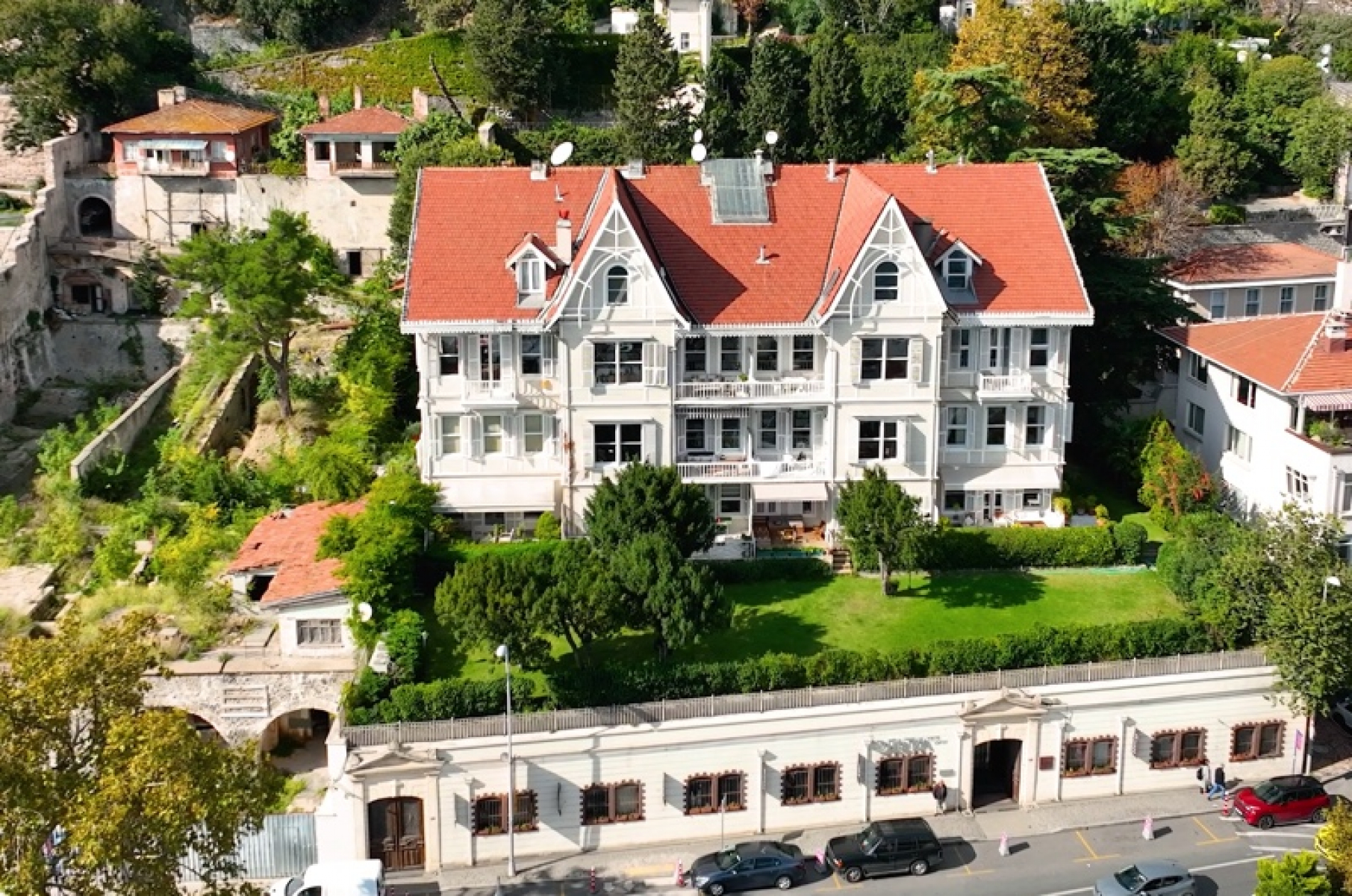

Büyükada, one of Istanbul’s unique beauties, captivates visitors not only with its natural landscapes but also with its enchanting historic mansions and architectural richness. Among the most striking and mysterious buildings on this rooted island is Mizzi Mansion, known among locals as Al Palas. So, what architectural features and dazzling decorative details lie hidden when you look closely at this red-bricked, towered structure? Let’s witness together the eclectic world of Mizzi Mansion (Al Palas) and the genius touches of D’Aronco.
The Dance of Architects: The Foundations of Mizzi Mansion and Lewis Mizzi’s Vision
The story of Mizzi Mansion begins in the late 19th century with the personal passion of Maltese lawyer and astronomer Lewis Mizzi. Although the mansion’s first owner was George Mizzi, it later came under Lewis Mizzi’s possession and actually reflected his passion for the sky. At a time when individual scientific initiatives were rare in the Ottoman Empire, Mizzi decided to add a modern observatory tower to his summer house. This decision was the first sign that the mansion would be more than just a residence — it would be a place devoted to science.
However, the real architectural masterpiece of Mizzi Mansion (Al Palas) came from the famous Italian architect Raimondo D’Aronco, who had come to Istanbul for the Ziraat and Sanayi Exhibition of Sultan Abdulhamid II. Severely damaged during the great 1894 Istanbul Earthquake, the mansion was brought back to life by D’Aronco’s skilled hands. Lewis Mizzi’s 1895 petition stated that his observatory on Büyükada was constructed according to plans prepared by Architect D’Aronco, clearly revealing the special bond between the two and the value the architect added to the mansion.
An Aesthetic Born from an Eclectic Dream: The Unique Architectural Features of Al Palas
The architectural style of Mizzi Mansion (Al Palas) is not confined to a single era or movement; rather, it presents an eclectic synthesis of different styles. D’Aronco’s design, as many sources note, blends the flowing and organic lines of Art Nouveau with neo-Gothic details inspired by the Italian Middle Ages.
-
Red Facade and the Name “Al Palas”: One of the mansion’s most striking features is its distinctive red brick front facade. This meticulous craftsmanship and distinct color led locals to call the building "Al Palas" (Red Palace). The use of red bricks distinguished it from other wooden mansions of the era and added a unique grandeur. The other facades are plastered.
-
Magnificence of the Entrance Facade: The mansion’s entrance facade has a veranda opening to the garden with arches. The exterior arches of the veranda are supported by brick buttresses, while the central passageway is carried by stone columns topped with capitals. The capitals are decorated with volutes, stylized vine leaves, and grape motifs. The stone moldings and buttresses, matching the color of the columns, create a striking contrast with the red bricks.
-
Window Designs: The upper floor windows have rectangular sections divided by wooden frames. This design, as noted by Baha Tanman, resembles the bay windows found in Greek houses around İzmir in the 19th century and is a feature of Late Victorian houses. Other facades feature round-arched windows on the ground floor, and flat lintels with stone frames on the upper floors.
-
Tower Structure and Neo-Gothic Influence: The mansion’s most eye-catching element is undoubtedly its observatory tower. This square-sectioned tower, attached to the northeast boundary, is built with bricks matching those on the front facade. On the ground floor level, there is a window within nested flat arches. This element also appears in D’Aronco’s renovation of the Yıldız Çini Factory between 1894-1895. The tower has a "medieval castle-like" appearance, especially with pointed arches on window frames and a turret-like top, reflecting neo-Gothic style.
Elegance Hidden in Details: The Decorative Art of Al Palas
The eclectic decorative art of Mizzi Mansion (Al Palas) combines the aesthetic delicacies of Art Nouveau with Gothic influences, giving the building a unique character.
-
Tower Details and Animal Figures: On the projecting part of the tower, there are nested arches decorated with a square-shaped rosette made of small white stones. Above this is a balcony with a cornice, flanked by stone parapets featuring geometric lines, and a front iron railing. The corbels supporting the cornice are painted white and shaped as winged lion figures, matching the white stone materials on the front facade. The lions have long legs, and behind them are floral and pinecone motifs in the same style as the metal railing. The underside of the cornice features a star-shaped, coffered wooden ceiling.
-
Flowing Lines of Art Nouveau: The tower’s iron railing is decorated with curving branches bearing pinecones, flowers, and leaves, colored with gold leaf and rose pink. These characteristic flowing, natural forms and plant motifs of Art Nouveau also appear in the mansion’s windows, doors, and other ironwork. This style softens the overall Gothic effect of the building and adds a graceful touch. Wrought iron railings and some wooden decorations highlight interlaced circles or stylized botanical patterns.
-
Original Lighting Elements: The only drawing in the D’Aronco archive is of lamps mounted on the veranda columns. These lamps are gilded and colored, featuring hybrid plant and animal forms. Curving branches hold flowers and pinecones intertwined with a stylized dragon figure. This curving form holds a glass container for a candle. Similar lamps were also seen at the 1884 Turin Exhibition.
-
Interior Decorations: Inside the mansion, the walls are done with “bağdadi” plaster technique. Ceilings are painted wood with molding, generally arranged in rectangular and polygonal forms. Only the ceiling of the main reception hall has a coffered appearance. The lower part of the staircase leading from the ground floor to the first floor is decorated with fresco-like motifs. These sections are surrounded by stylized plant borders in brown tones on a yellow background. The stair railing features Baroque compositions such as oval "C" shapes and palmettes.
The Mansion’s Plan and Interior Layout
Mizzi Mansion is a three-story masonry building including a basement. Located within a spacious garden, the mansion’s front has a courtyard with a pool and a wide oval staircase.
-
Ground Floor: The ground floor plan includes a north-south rectangular salon reached from the entrance, surrounded by rooms. To the east are the kitchen and dining room; to the west, the stairwell, two rooms, and restroom areas. There is also a rear garden entrance. The tower connects to the veranda and dining room on the entrance floor. The tower has rooms on the ground and first floors.
-
First Floor: The first floor’s area is smaller than the ground floor’s, resulting in a narrower common salon surrounded by eight units of different sizes. One eastern unit is a large bathroom. The northeast unit connects to the tower, while the northwest unit opens onto a polygonal balcony.
-
Attic Floor: The smallest floor area, with three rooms opening onto a corridor. A metal staircase on the tower’s exterior leads up to the attic. Behind the mansion is a two-story annex with a linear plan, including pantry and kitchen units arranged consecutively.
A Legacy Through the Time Tunnel: Transformations and Present-Day Value
Mizzi Mansion (Al Palas), shaped by Lewis Mizzi’s passion for science and Raimondo D’Aronco’s architectural genius, hosted astronomers such as Eugenios Mihail Antoniadis. Over time, its function changed, and it served as Hotel San Remo in the 1930s and 1940s. Unfortunately, the telescope section in the observatory tower was removed in the 1950s due to decay. However, extensive renovations beginning in the 2000s restored much of the architectural integrity. During the last restoration, later additions were removed, original wooden craftsmanship was emulated, and the northwest viewing terrace’s railing and the round-arched balcony beneath were rebuilt according to the original condition.
Today, Mizzi Mansion (Al Palas) stands proudly in Büyükada’s Nizam Neighborhood as a private property. Although not open to the public, the mansion can be admired from outside as a unique representative of Art Nouveau architecture, neo-Gothic influences, and eclectic decorative art, holding an important place in Istanbul’s and Büyükada’s cultural heritage.