
Büyükada, Istanbul’s beloved getaway, has always possessed a captivating atmosphere with its lush nature, nostalgic horse-drawn carriages, and of course, its magnificent waterfront mansions. However, the island’s deep-rooted past is not limited to its social life. Hosting scientific discoveries, architectural geniuses, and a multicultural heritage throughout history, one of Büyükada’s most special secrets is Mizzi Mansion (Al Palas). Once home to a telescope in its tower that studied the sky, this unique structure carries the Ottoman Empire’s reach toward modern science into the present, combining it with the elegance of Art Nouveau architecture.
The Reflection of Sky Curiosity on the Island: Lewis Mizzi and the Birth of the Observatory
The story of Mizzi Mansion begins with its first owner, George Mizzi. Subsequently, it changed hands multiple times through inheritance and sale. Historian Akillas Milas notes that the original owners were Greek Orthodox, and later the mansion became the property of Lewis Mizzi, a lawyer who handled its foreclosure case. Although it is not exactly known when Mizzi acquired the mansion, archival documents discovered after the 1894 earthquake and contemporary press records prove that Lewis Mizzi was the owner during the 1890s.
Lewis Mizzi, of Maltese origin and a significant figure in the Ottoman Levantine community, shaped his life not only through a brilliant career in law and diplomacy but also through a great passion for astronomy. Graduating from the University of Malta with a law degree in 1868, Mizzi worked for many years as a lawyer in Greece and Ottoman territories. Arriving in Istanbul around 1872, he quickly became one of the city’s most respected and prestigious lawyers. Mizzi was also the owner and editor of The Levant Herald and Eastern Express, a weekly English-language newspaper published in Istanbul. Fluent in several languages and a respected intellectual, Lewis Mizzi was a scholar holding a doctorate in law. His deep interest in astronomy led him to become a member of astronomy societies in England, France, and the Pacific region. Having studied in Italy as well as Malta, Mizzi maintained close ties with Istanbul’s Italian community and played a major role in spreading Italian culture and language in the city.
Continuing his intensive work in Istanbul, Mizzi decided to add a special tower to his Büyükada summer house for making personal astronomical observations. This decision was a striking example of how strong individual scientific curiosity could be in the Ottoman context.
The Büyükada Earthquake: The Little Apocalypse
The 1894 earthquake, known in Ottoman sources as the "Great Earthquake Movement" or the "Little Apocalypse," caused the destruction or serious damage of many buildings in Istanbul and the Princes’ Islands. A report prepared under the leadership of the director of the Athens Observatory and submitted to Sultan Abdulhamid II stated that the greatest damage was in the Islands. The report noted that masonry buildings collapsed, while wooden structures were mostly unharmed. Mizzi Mansion (Al Palas) was among the buildings significantly damaged in this earthquake. Following the earthquake, contemporary press coverage included news about the damage to Mizzi Mansion alongside other prominent buildings in the Islands, estimating repair costs around 15,000 francs, particularly for the observatory tower.
Lady Dorina L. Neave, who experienced the Istanbul earthquake, recalled in her memoirs the great destruction on the Islands and mentioned the heavily damaged villas of family friends "Sir Edwin Pears and Dr. Mizzi."
As a result of the extensive damage, the mansion was partially rebuilt like many other buildings in Istanbul and the Islands. This reconstruction was carried out by Raimondo D'Aronco, an Italian architect newly arrived in Istanbul. It is believed that Mizzi and D'Aronco met through Italian associations to which Mizzi belonged. Roberto Albanese noted that D'Aronco traveled extensively across Europe with his family and stayed with the Mizzi family at a thermal hotel in the Alps in 1895. This suggests a close friendship beyond their professional relationship.
D’Aronco’s Touch: An Architectural Masterpiece — Mizzi Mansion (Al Palas)
Raimondo D’Aronco arrived in Istanbul in July 1893 to design and execute the Agricultural and Industrial Exhibition planned by Sultan Abdulhamid II. This exhibition aimed to promote Ottoman agricultural and industrial products internationally and to apply Western technology to regional economic development. Preparations lasted nearly a year but were canceled due to the devastating Istanbul earthquake on July 10, 1894.
Immediately after the earthquake, Sultan Abdulhamid II ordered the establishment of a commission to inspect and repair official offices, military buildings, and foundation properties. D’Aronco was included in this commission, called "heyet-i fenniye," alongside Sarkis Balyan, Alexandre Vallaury, and engineer André Berthier, participating in repair works. During this unplanned restoration duty, his exposure to Byzantine and Ottoman monuments propelled him into the most productive period of his career.
Aside from repair work, about six months after the earthquake, D’Aronco was tasked with designing an observatory. The devastating quake revealed the Ottoman Empire’s deficiencies in seismology. There was a proposal to invite European experts to conduct seismological research. Among several suggestions, they chose an Italian expert from Rome with a strong reputation in earthquake history. Thus, Professor Giovanni Agamennone arrived in Istanbul.
Research showed that the Observatory in Pera (Rasathane-i Âmire) was inadequate for new equipment due to its location and capacity. Work began to build a new observatory, initially planned for the Darülaceze area in Şişli — the location of the canceled Agricultural and Industrial Exhibition, D’Aronco’s original assignment. The building was designed, but its implementation and budget exceeded limits, so the project was postponed.
Upon Sultan Abdulhamid II’s suggestion, a plot opposite Maçka Silahhanesi was chosen. D’Aronco surveyed and designed a new observatory there. The May 6, 1895 design consisted of a two-unit building. Period newspapers mentioned that the building was operational, but no trace of such a structure has been found in today’s Maçka Campus of ITU.
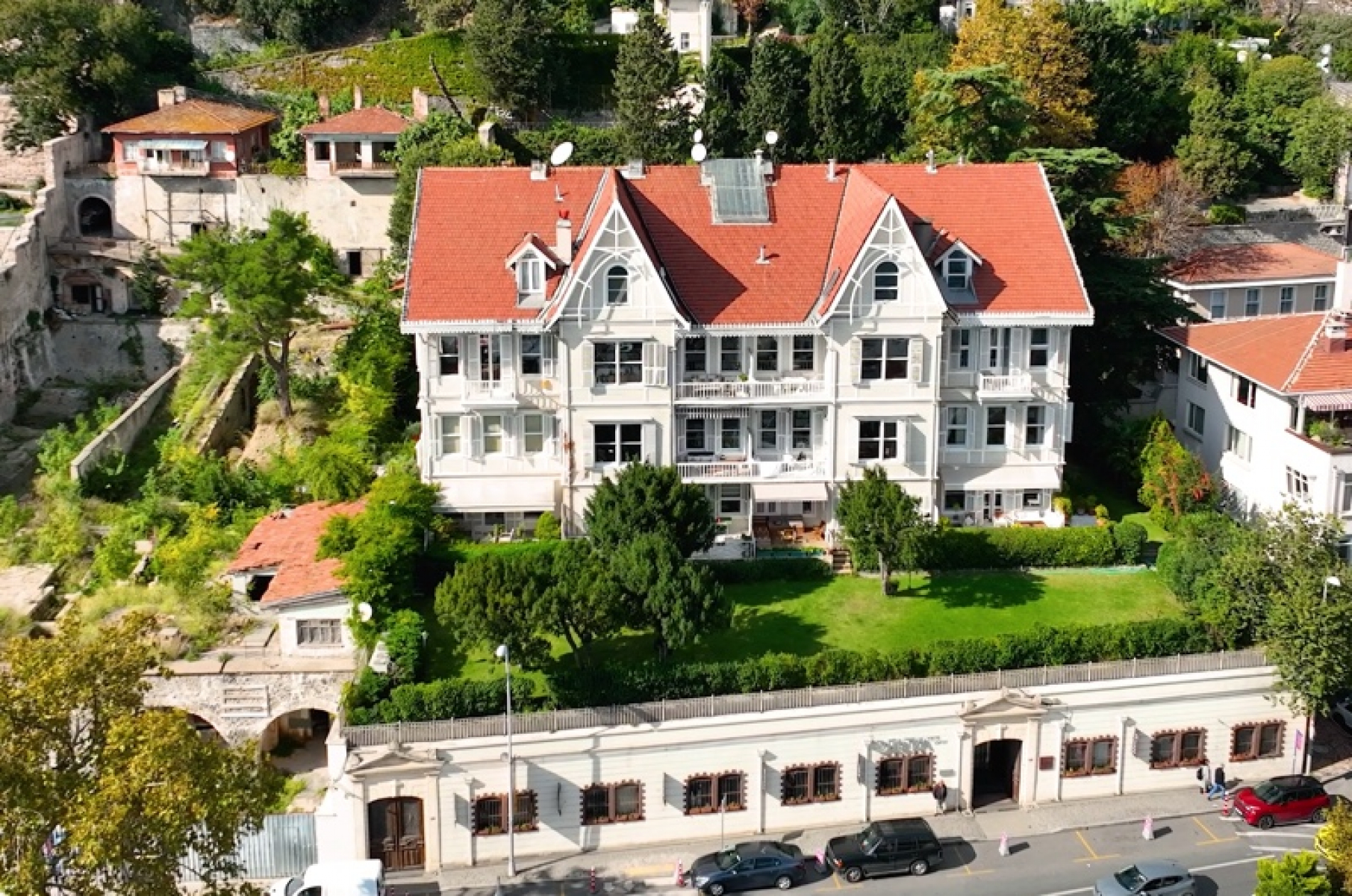
The architectural genius who would bring Lewis Mizzi’s scientific dreams to life was Raimondo D’Aronco, one of the most important figures of Ottoman Art Nouveau. His unique design combined a tower decorated with neo-Gothic details inspired by the Italian Middle Ages with the flowing, elegant lines of Art Nouveau. The observatory tower added to the mansion was equipped with modern telescopes, providing a rare scientific infrastructure in Ottoman lands.
On January 4, 1895, Lewis Mizzi wrote to the Sadaret, mentioning his membership in world-famous astronomy societies and stating that he had established two observatories: one adjacent to his house on Büyükada and the other at his residence on Su Terazisi Street in Beyoğlu. He noted he had procured the necessary equipment and emphasized that the Büyükada observatory was constructed according to plans and maps prepared by Architect D’Aronco, making it architecturally superior to others. He added that he would hand over these observatories free of charge to the teachers and students of the Naval Academy on Heybeliada to promote scientific development and research in the Ottoman Empire.
The building damaged in the great 1894 Istanbul earthquake was revitalized by D’Aronco. Known colloquially as "Al Palas," Mizzi Mansion stands out in Büyükada’s Nizam Neighborhood, especially with its red facade. This mansion is not only a residence but also a unique work of art where science and architecture meet.
A Scientist Rising from Büyükada: Eugenios Antoniadis
The observatory in Mizzi Mansion (Al Palas) also became a scientific center for Eugenios Mihail Antoniadis, one of Büyükada’s prominent astronomers. Antoniadis made his initial observations here, conducting notable studies on Mars and sunspots. He later moved these valuable studies to Paris and shared them with Camille Flammarion, president of the renowned French Astronomical Society (Société Astronomique de France), gaining international recognition.
His detailed drawings and findings on the Martian surface shed scientific light on the then-heated debate about Martian canals. Antoniadis became one of the 20th century’s most important Mars experts. Mizzi Mansion (Al Palas) served as a scientific cradle, inspiring future generations of astronomers.
Transformations of Mizzi Mansion (Al Palas): From Hotel San Remo to Today
After the proclamation of the Republic, like many mansions on Büyükada, Mizzi Mansion (Al Palas) took on different functions. Between the 1930s and 1940s, it was converted into a hotel named Hotel San Remo. Unfortunately, the glass-enclosed section housing the telescope was removed due to decay in the 1950s, but the architectural integrity of the building has been restored thanks to meticulous restoration efforts in recent years.
Today, with the completion of extensive renovations starting in the 2000s, Mizzi Mansion (Al Palas) shines once again. Embellished with the scientific light of the past, elegant architecture, and rich cultural texture, this structure is not only a rare scientific center symbolizing the Ottoman Empire’s encounter with modern science but also a time capsule adorned with Art Nouveau architecture.